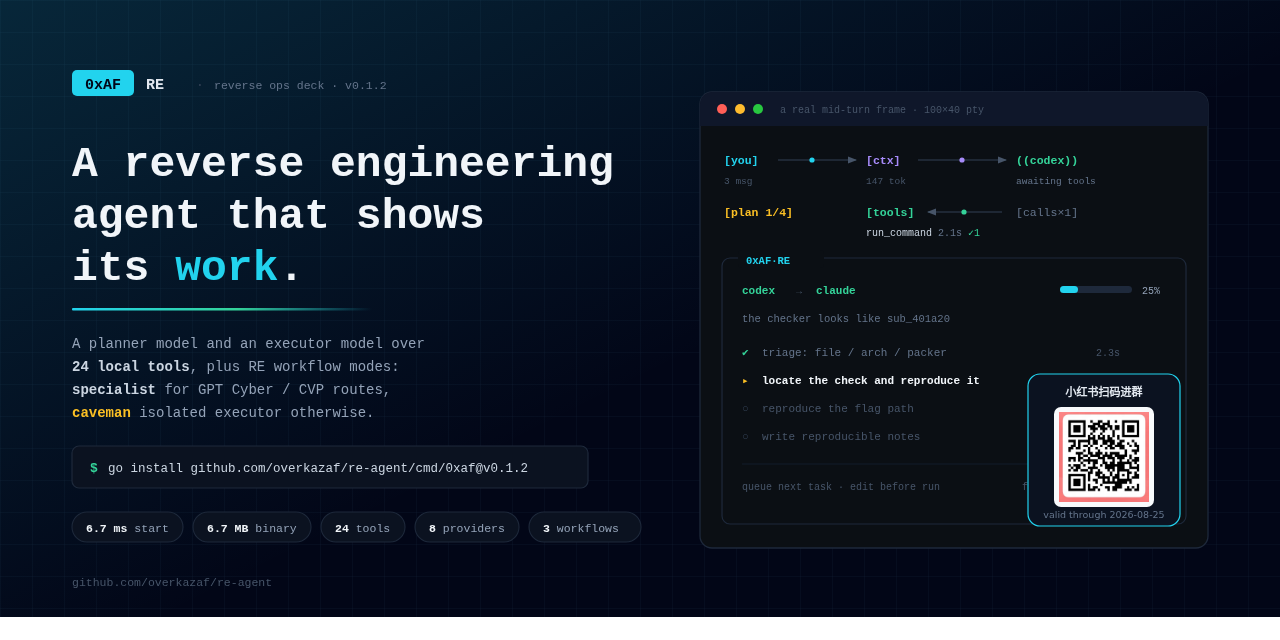
0xAF-Re drives a planner model and an executor model over
24 local tools — triage, entropy, carving, symbols, APK inspection, Frida scaffolds, external RE tool wrappers —
plus workflow modes that route GPT Cyber, Claude Code CVP, Grok, or similar specialist subscriptions directly,
break ordinary-provider work into local evidence packets, and queue your next prompt while the current turn runs.
It draws the turn while it runs, so you can see where the time went and stop it when it goes
somewhere useless. One static binary. No runtime to install.
6.7 ms start6.7 MB binary24 tools8 providers3 workflows1 dependency
a real mid-turn frame · 100×40 pty
Nothing here is a mock-up: this frame was lifted out of a captured session while a
run_command call was still running.
why it is built this way
Built after ordinary coding agents got less useful for RE.
The project started from daily authorized RE/CTF work where CLI risk controls tightened
and general models became more cautious around reverse-engineering language. 0xAF-Re does
not hide intent. It keeps work local, authorized, and auditable, then composes models so
each one handles the part it is good at.
Model composition
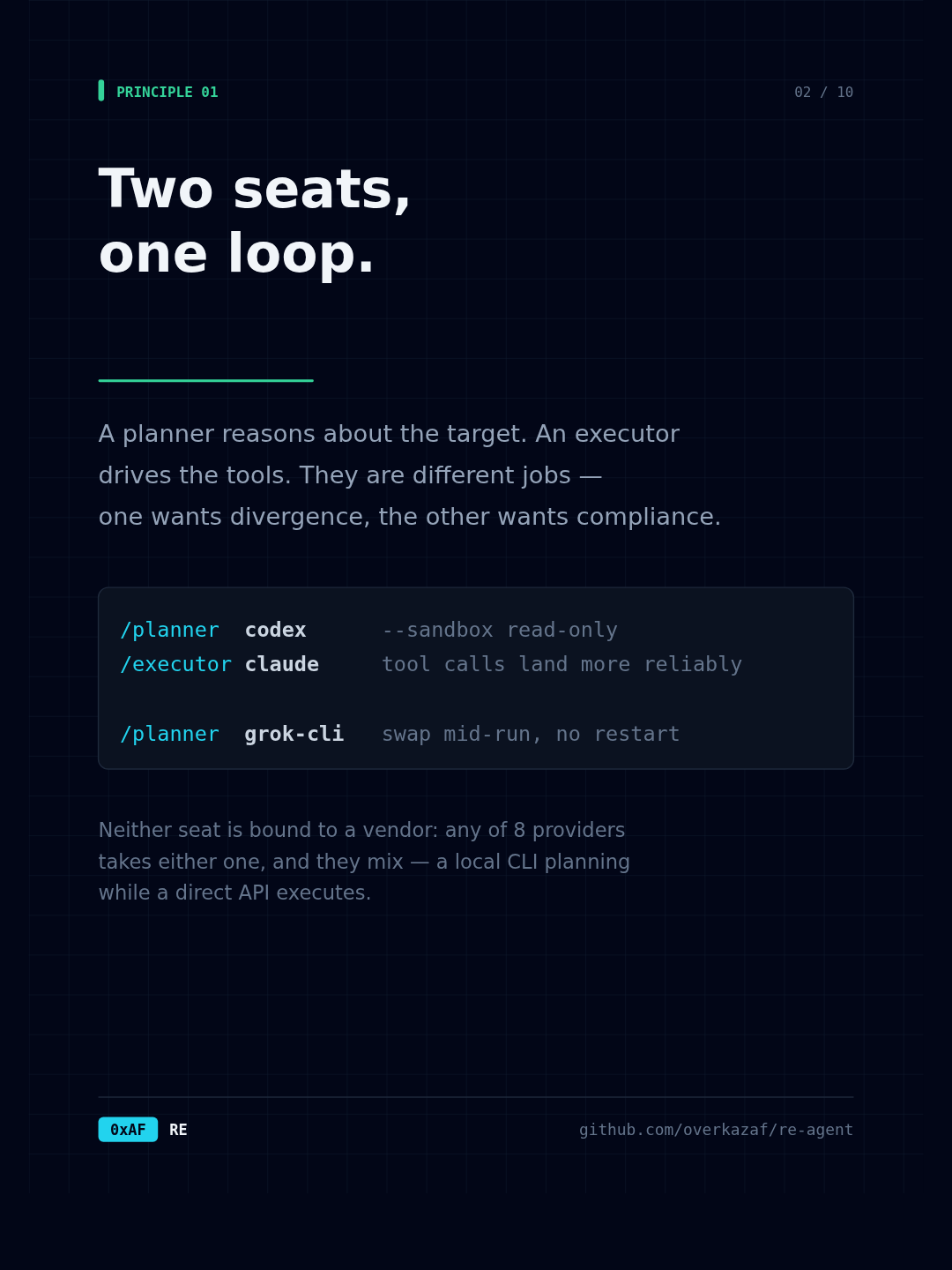
A planner reasons about the target, an executor drives local tools, and a researcher
gathers background context. Each role can use a different provider or model, switched
live with /planner, /executor,
/researcher, and /model.
Specialist when available
If you have GPT Cyber, Claude Code CVP, Grok, or a similar route that is tuned for
security research, /workflow auto can take the specialist
path and keep planning plus tool work in one smoother loop.
Caveman for ordinary models
Without a specialist route, caveman mode splits the task into a full planner view and
a narrow executor packet. The executor sees local evidence requests, not the whole
objective, and uses a read-only toolset for file facts.
One binary
Prompts and skills are embedded. make cross builds
linux/darwin × amd64/arm64. The boxes where lab work actually happens rarely have a
JS runtime, and you should not have to install one to triage a binary.
Roadmap with measurements
Local model routes and concrete evaluation samples are planned so the agent can be
measured: same artifact, same workflow, different provider. That gives the project a
practical way to improve instead of relying on anecdotes.
Cancellation that lands
^C cancels the HTTP request, kills the tmux session, and signals tool
subprocesses in their own process group. No orphaned
objdump chewing a core after you walked away.
Contained by default
Reads stay inside the workspace. Writes are off until you pass
--write. Network and credential-shaped commands stop and
ask. Destructive shell forms are refused.
use cases
Ten good first prompts.
Replace the paths with your own artifacts. Slash commands run local tools directly;
-p starts an agent turn.
#
goal
start with
1
Unknown CTF file
/scan ./chall
2
Native binary protections
/mitigations ./chall
3
Packed or encrypted region
/entropy ./chall
4
Embedded payloads
/carve ./blob
5
Encoded flag or token
/decode auto ZmxhZ3s...
6
Android APK first pass
/apk ./app.apk
7
Java or native hook scaffold
/hook java com.example.Crypto sign
8
radare2/JADX/Ghidra/Burp/mitmproxy/angr inventory
/retool inventory
9
Web/WASM crypto challenge
/skill web-wasm-crypto inspect ./dist/app.js and ./dist/module.wasm
10
Background research with sources
0xaf --role researcher -p "Research this packer name and list safe local checks"
the turn, drawn
Two layers: one animates, one stays.
The diagram animates above the HUD while the turn runs — packets move
along the wires, nodes light up as they take part, and the loop closes back into the
context that feeds the next request. The task list hangs off
[you], because the plan is the operator's view of the work.
The trace lands in the scrollback and stays there, stamped from the start
of the turn, so a finished run reads like a packet capture. Duration bars share one scale
per turn — the slowest request fills the bar — which makes the shape of a turn readable at
a glance: where the time went, how many round trips it took, which tool was slow.
auto/auto ❯ triage artifact.txt and decode whatever payload it carries
Plan updates appear as transitions, never as dumps. A list still being written
stays silent until something actually moves.
the same turn, ending
The task list is archived into the scrollback once, at the end of a turn that touched
it — then the markdown reply, then what the turn cost.
# pick your layers; the choice is saved
/flow full diagram + trace (default)
/flow flow diagram only
/flow trace trace lines only
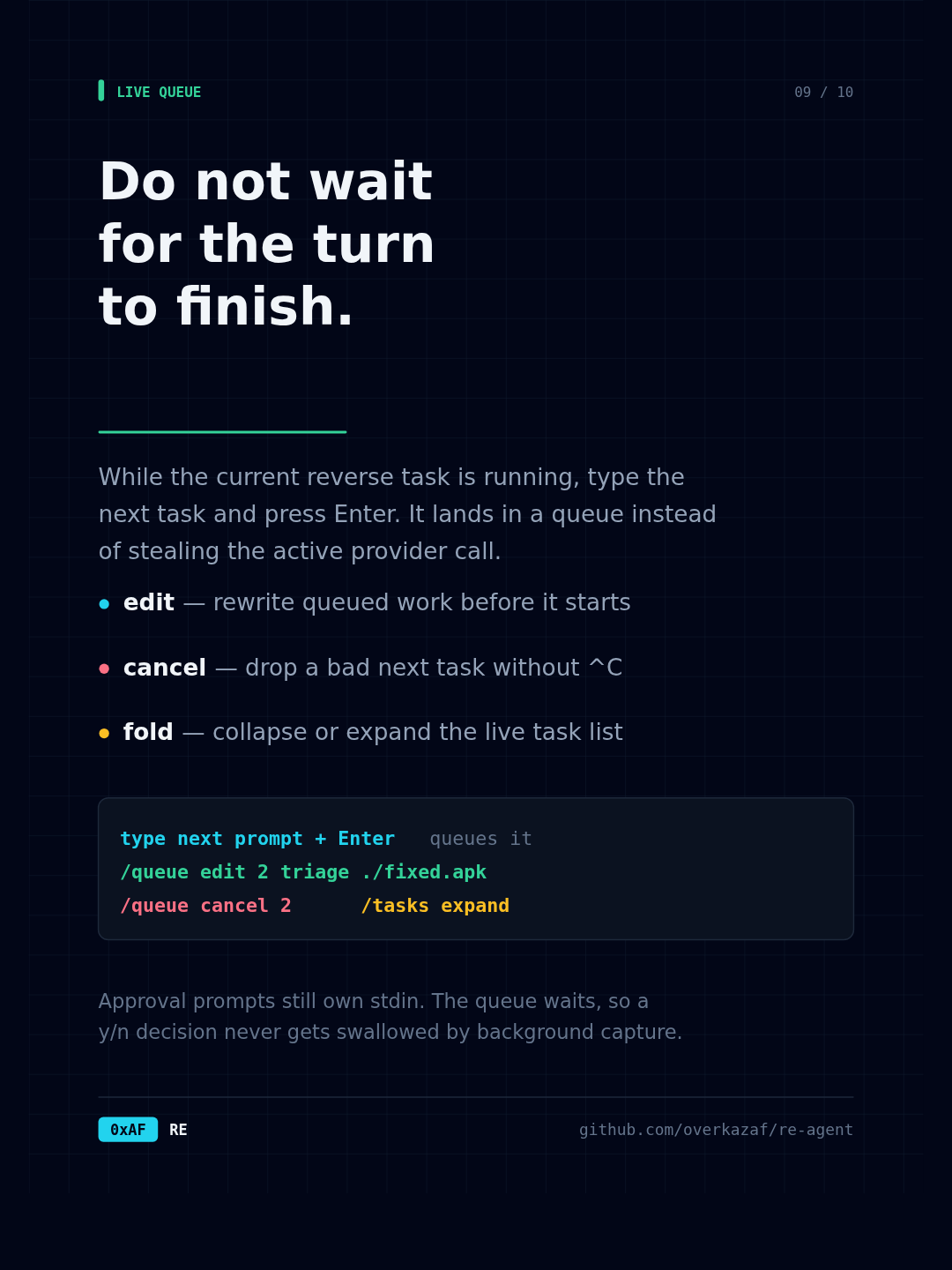
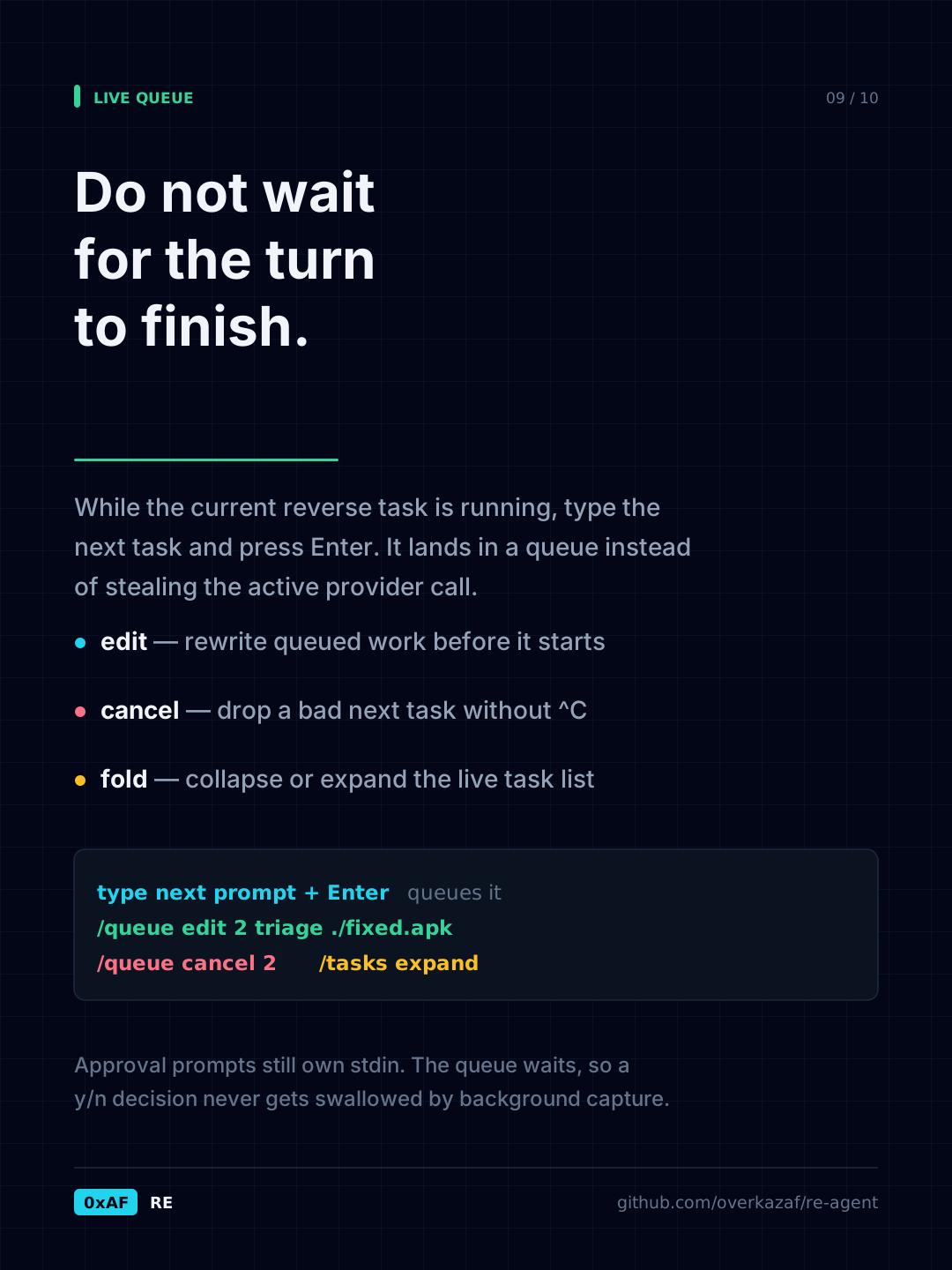
/flow off neither — the plain tool tree comes back# while a turn is running, type the next task and Enter to queue it
/queue list
/queue edit 2 triage ./fixed.apk
/queue cancel 2
/tasks collapse
/tasks expand
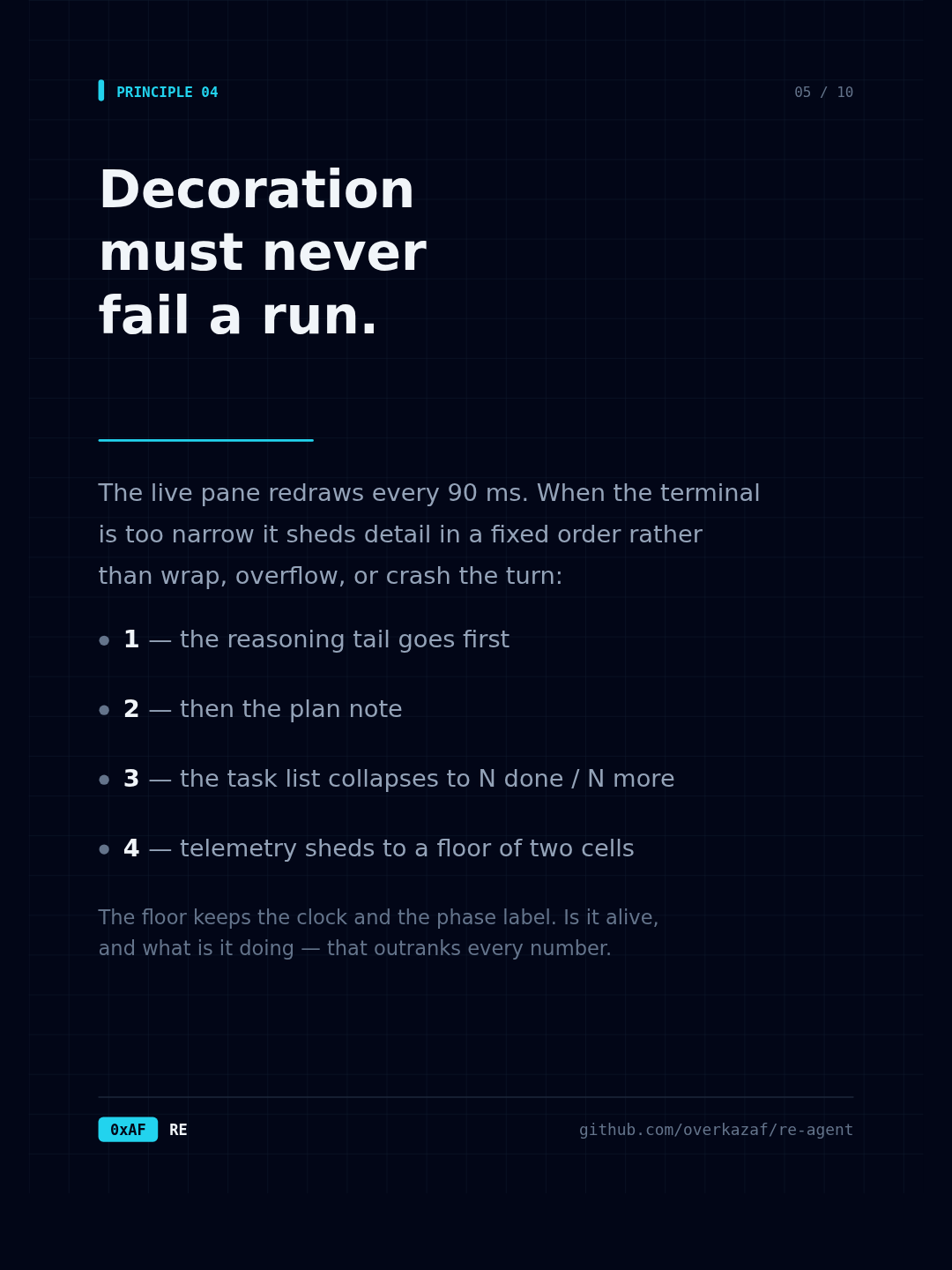
The diagram hides itself below 46 columns and in non-TTY output; the trace degrades to
plain text without escape sequences, which is what you want when piping a run into a log.
boot screen
Every line is a real probe.
Runtime, tmux, a shallow magic-byte triage of the workspace, provider auth, tool
inventory, active policy. The boot screen doubles as the answer to "is this thing
actually wired up right now?"
$ 0xaf --workspace ./demos/reverse-lab
A missing tmux is reported, not fatal — the CLI providers fall back to running directly.
Under --role auto each prompt is routed by shape:
execution-flavoured prompts ("run", "inspect ./", "读取") go to the executor, everything
else to the planner. You can override per session or per prompt.
control
effect
--role planner
analysis, exploitability reasoning, solve plans
--role executor
tools, file inspection, summarizing
--role researcher
background research, source synthesis, prior art
/agent <name>
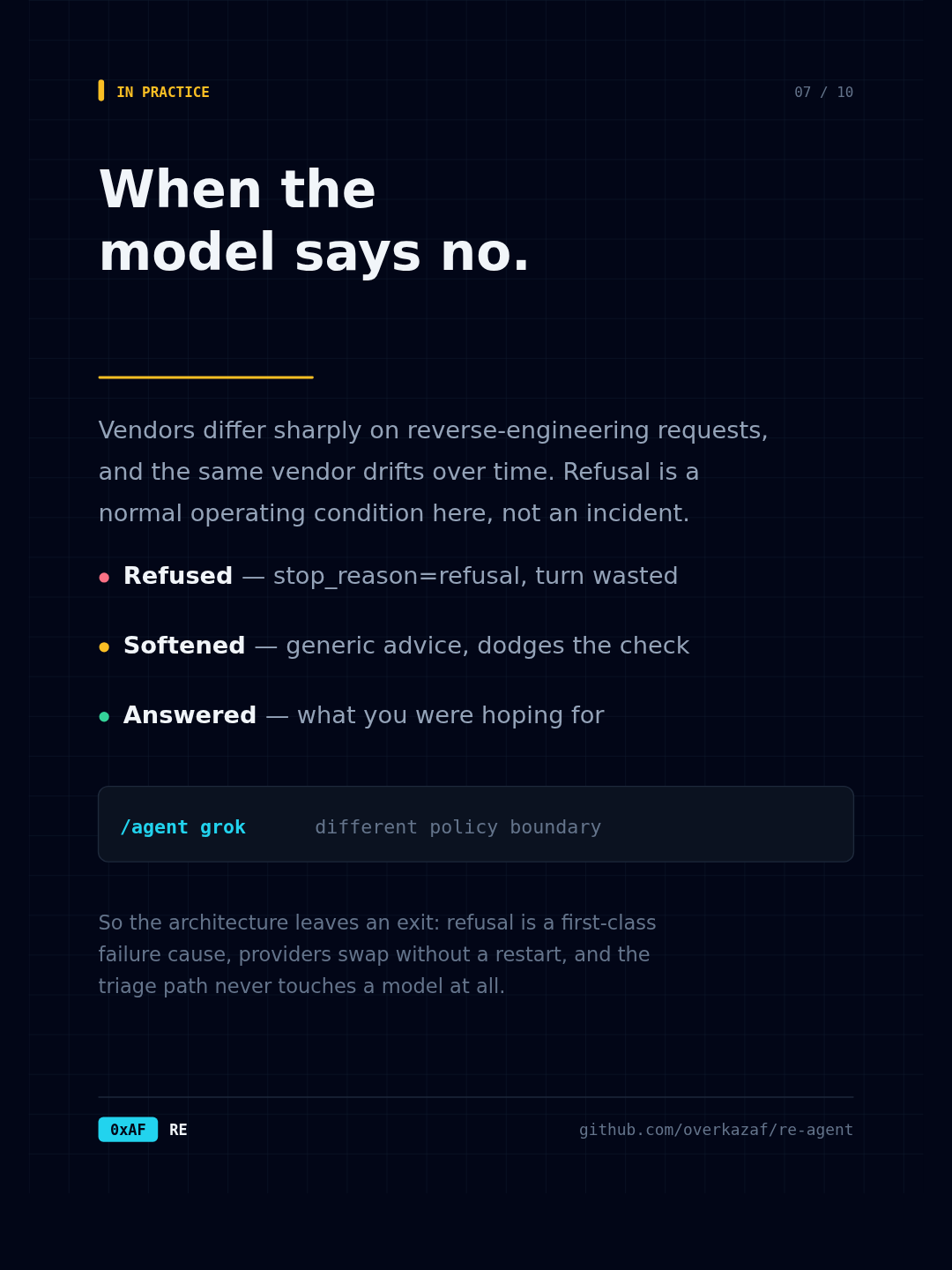
pin one provider for the next prompts
/model <provider> <model>
override the concrete model for this session
/planner · /executor · /researcher
change a role provider mid-session
/prompt list · /prompt path executor
inspect active prompt sources and editable file paths
/prompt edit researcher
edit system, planner, executor, or researcher prompts without rebuilding
/effort codex high
reasoning effort, for backends that take one
Editable prompt targets are system,
planner, executor, and
researcher. Edits are seeded from embedded prompts, saved under
prompts/ or ~/.0xaf-re-agent/prompts/,
and reloaded immediately.
auto/auto ❯ /providers
Eight providers ship: three local CLIs through tmux, Anthropic Messages, OpenAI
Responses, any OpenAI-compatible chat endpoint, and an offline mock the tests and
--smoke use.
workflow modes
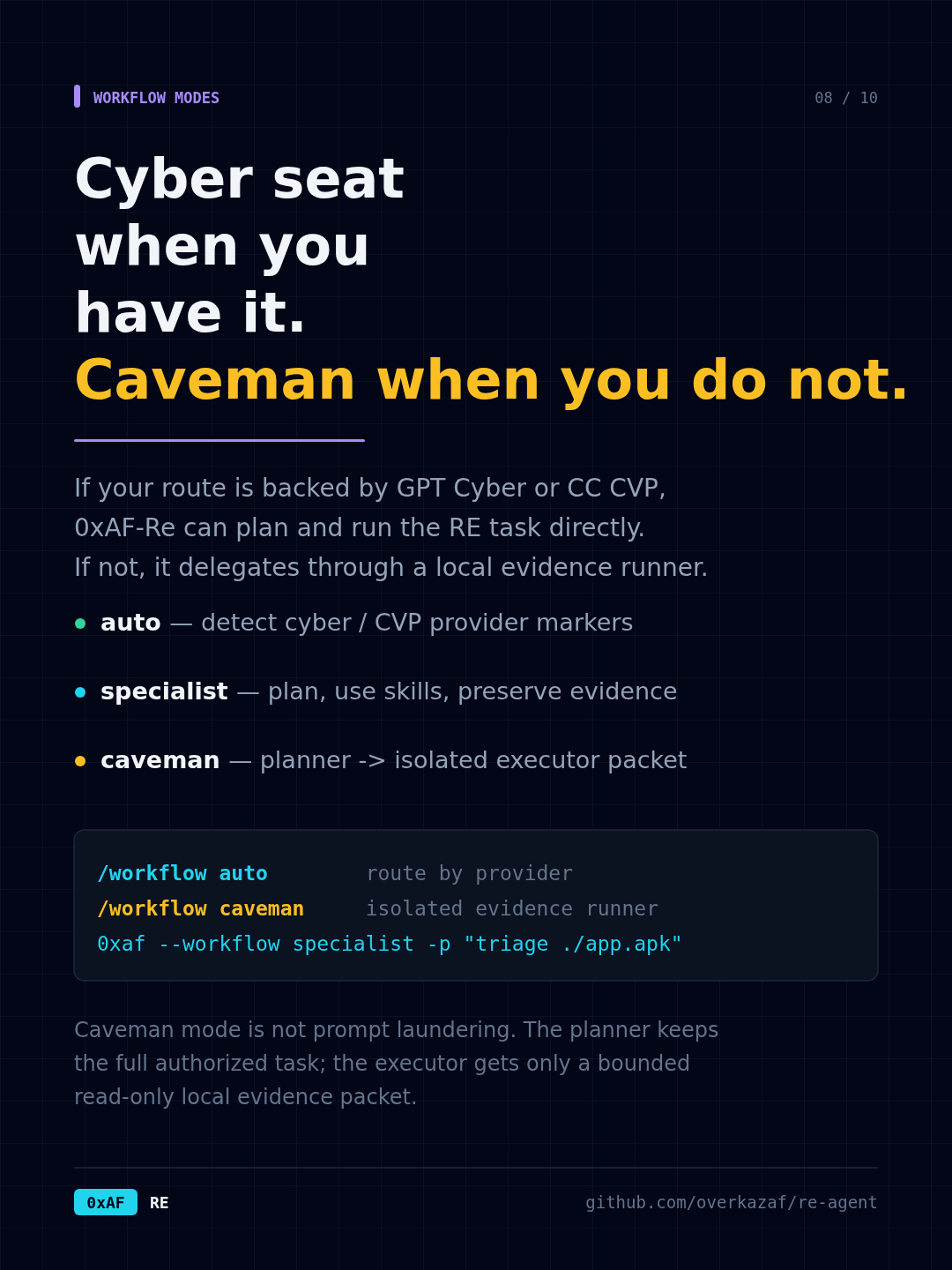
Specialist when you have it. Caveman when you do not.
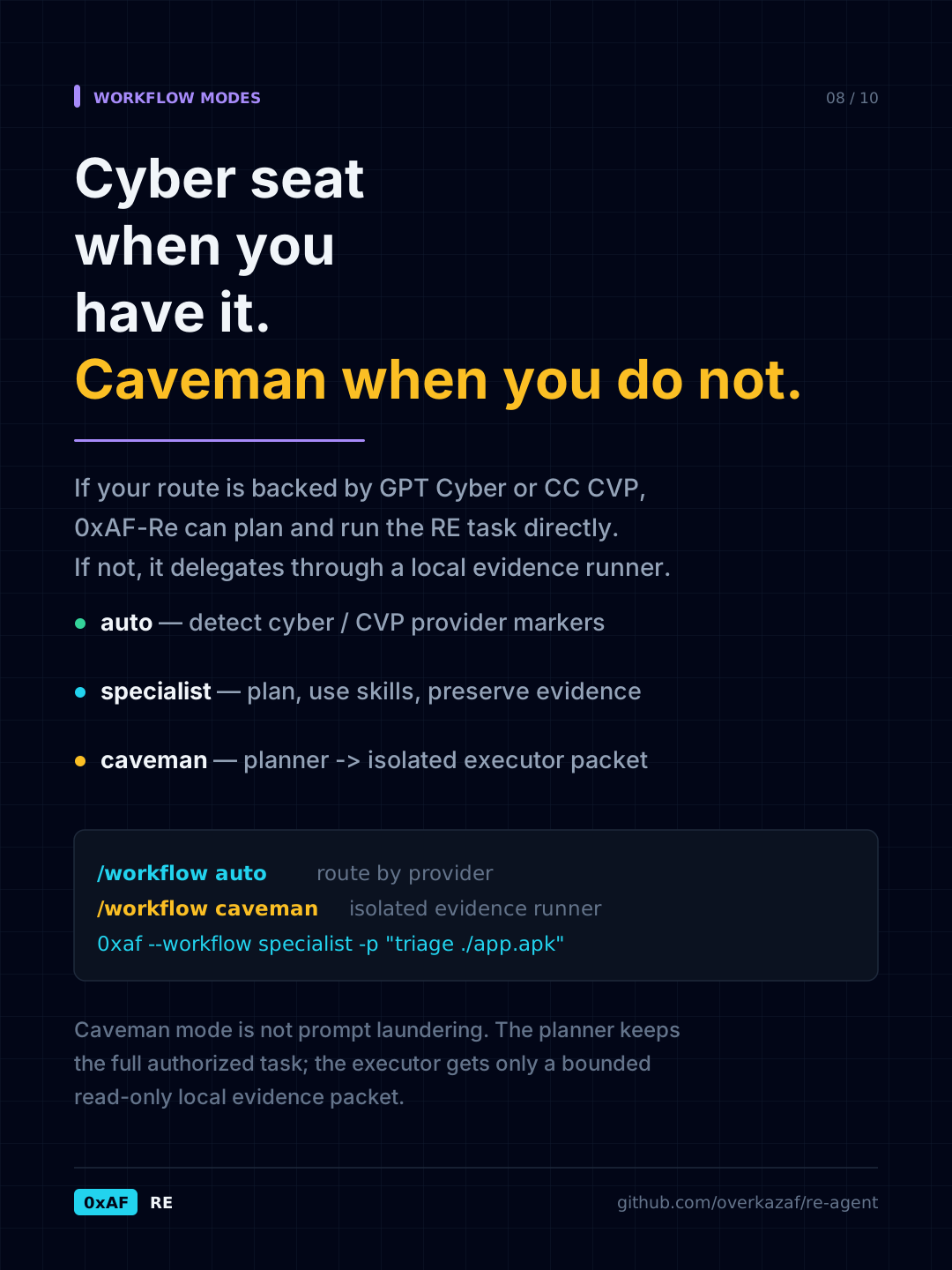
Workflow mode is explicit: the default is off, so ordinary
prompts are sent as-is. When turned on, 0xAF-Re shapes authorized reverse-engineering
requests before they reach the selected provider.
plans first, then runs skills and local tools while preserving evidence
caveman
ordinary providers
planner -> isolated executor, passing only a bounded local evidence packet
/workflow auto                 use specialist if a cyber/CVP route is configured
/workflow caveman              planner writes packet, executor collects local evidence
0xaf --workflow specialist -p "triage ./app.apk"
Caveman mode is not translation, classical Chinese, ciphering, euphemism, or prompt
laundering. The planner sees the authorized task; the executor starts fresh with a
narrow read-only tool surface for local file evidence, and unsafe live-target work is
refused rather than hidden.
delegated local evidence flow
what happens
1 · planner phase
planner sees the full authorized task and writes a short plan plus an EXECUTOR_PACKET
2 · isolated executor
executor starts a fresh provider session with only that packet, a dedicated system prompt, and narrowed tools
3 · evidence tools
executor can list, read, grep, hash, run strings/hexdump, scan entropy, inspect symbols, mitigations, carved signatures, and APK structure
4 · merged result
both phases are recorded in one transcript and returned as a combined planner->executor run
auto is just the resolver: specialist if a cyber/CVP marker is
configured, otherwise caveman. The two-phase delegated path only runs when the role is
auto and no provider is pinned; explicit roles or forced providers
keep their normal meaning and receive only the workflow prompt wrapper.
It does not bypass provider safety systems or hide marked intent. The practical effect is
narrower legitimate context: the planner handles the full authorized objective, the
executor receives only workspace-local evidence steps, the callable tools are read-only,
and both phases remain visible in the transcript.
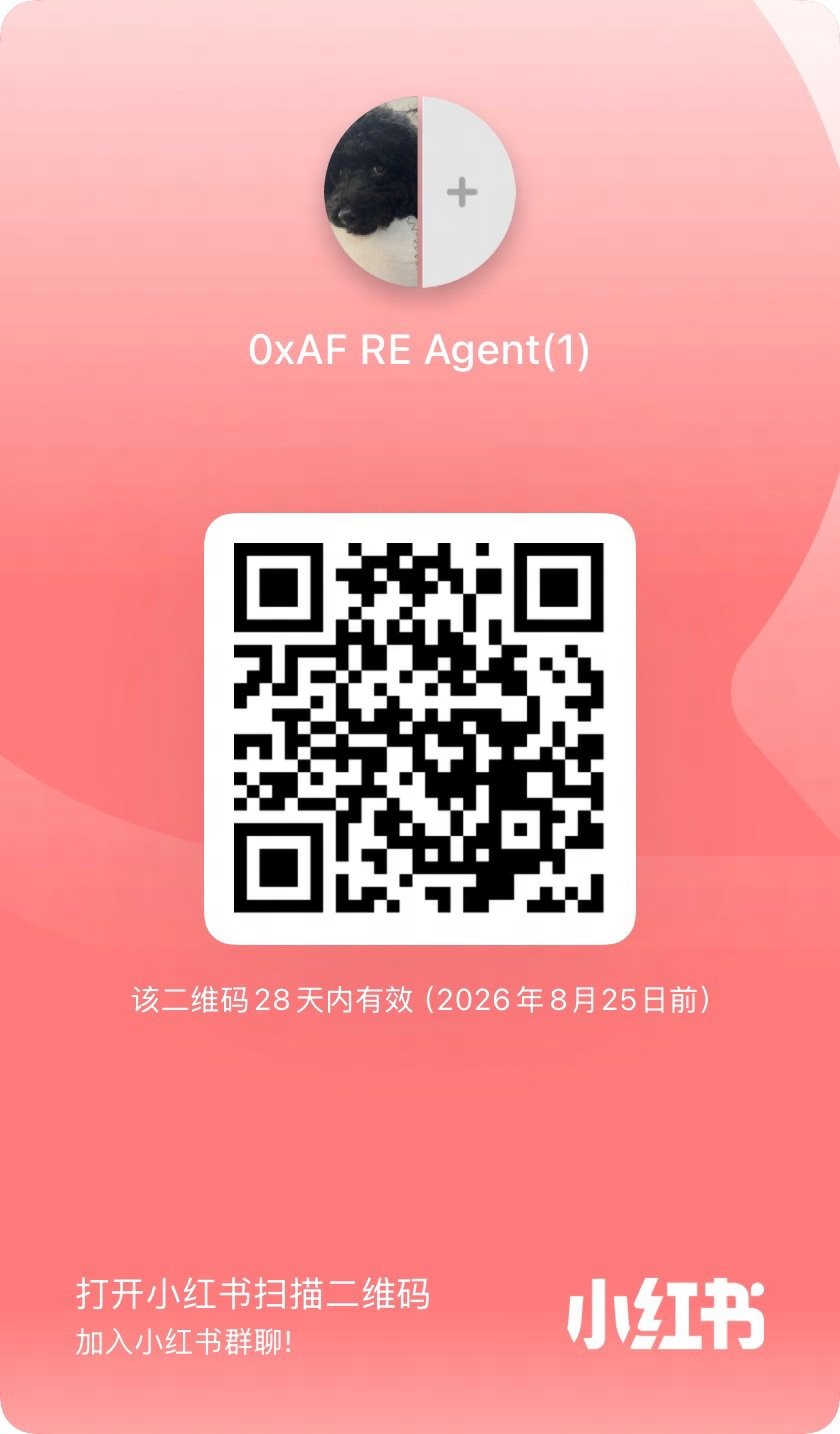
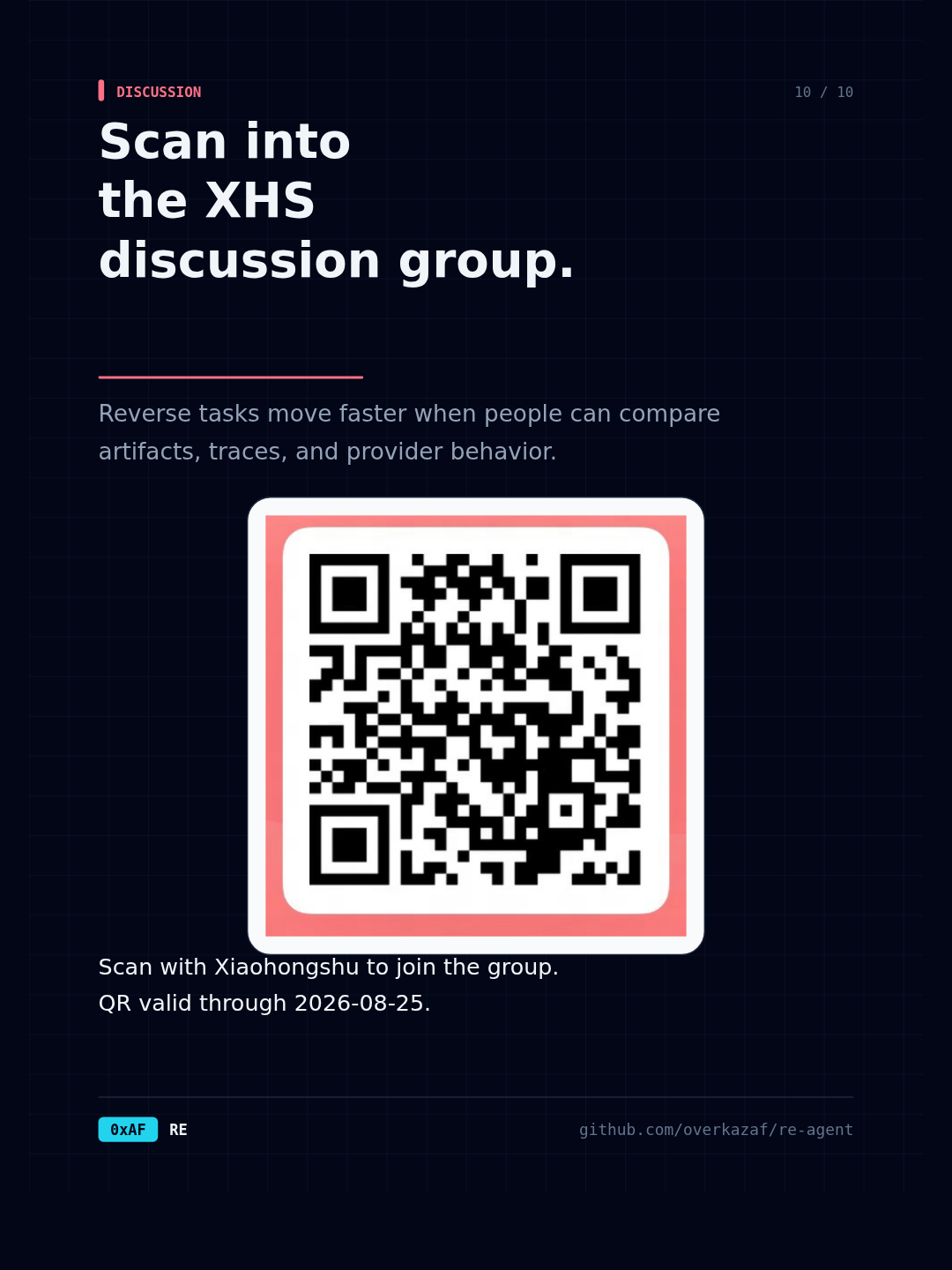
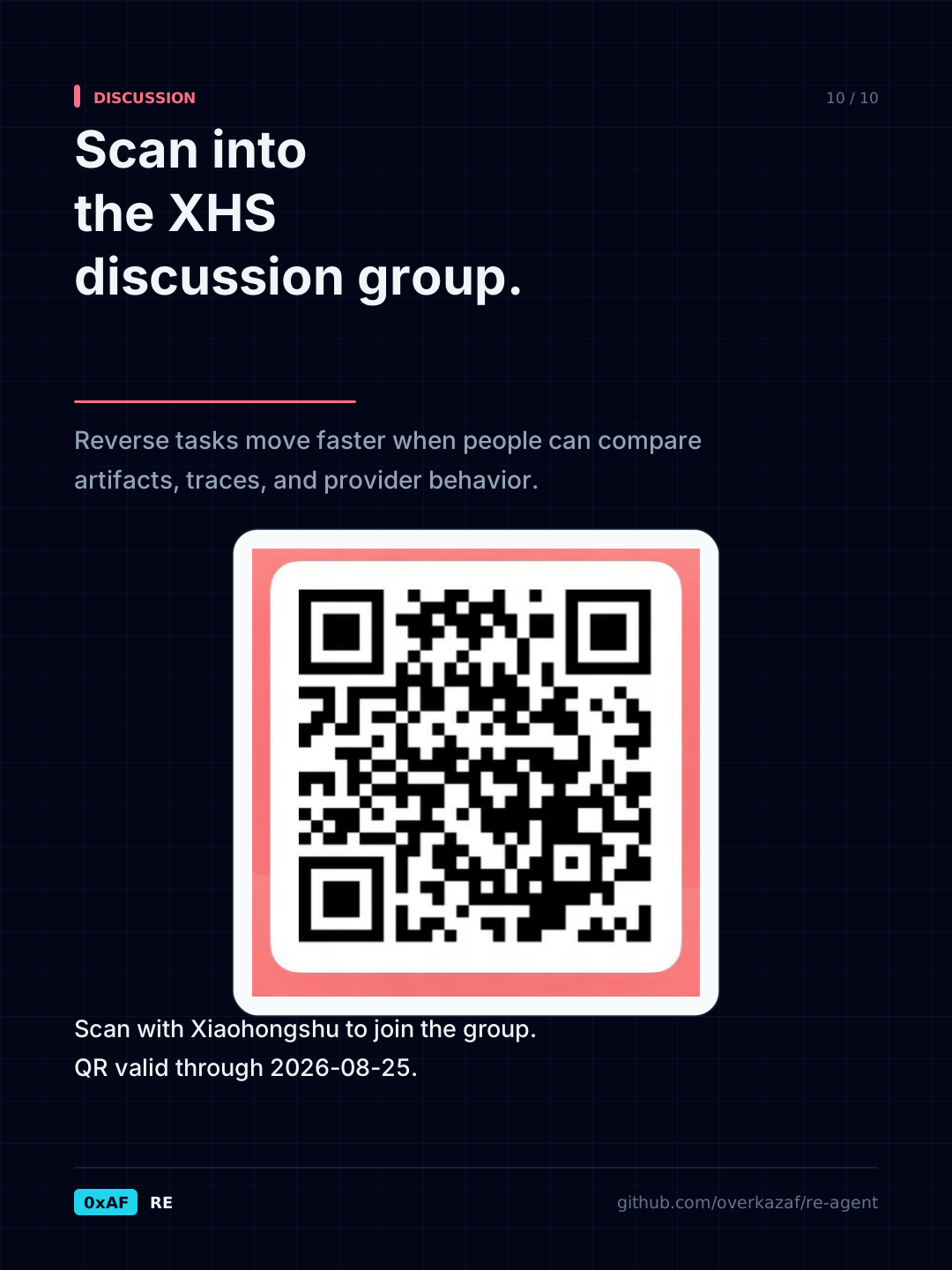
Xiaohongshu discussion group
Scan this code in Xiaohongshu to join the 0xAF RE Agent discussion group for
reverse-engineering tasks, provider behavior, workflow feedback, and artifact triage.
二维码有效期至 2026-08-25。
marketing downloads
Images ready for Xiaohongshu and Moments.
These PNGs are rendered into the page so you can preview them, then click any image
or button to download the original file. The vertical cards are 1080×1440, and the
1280×640 banner includes the group QR code.
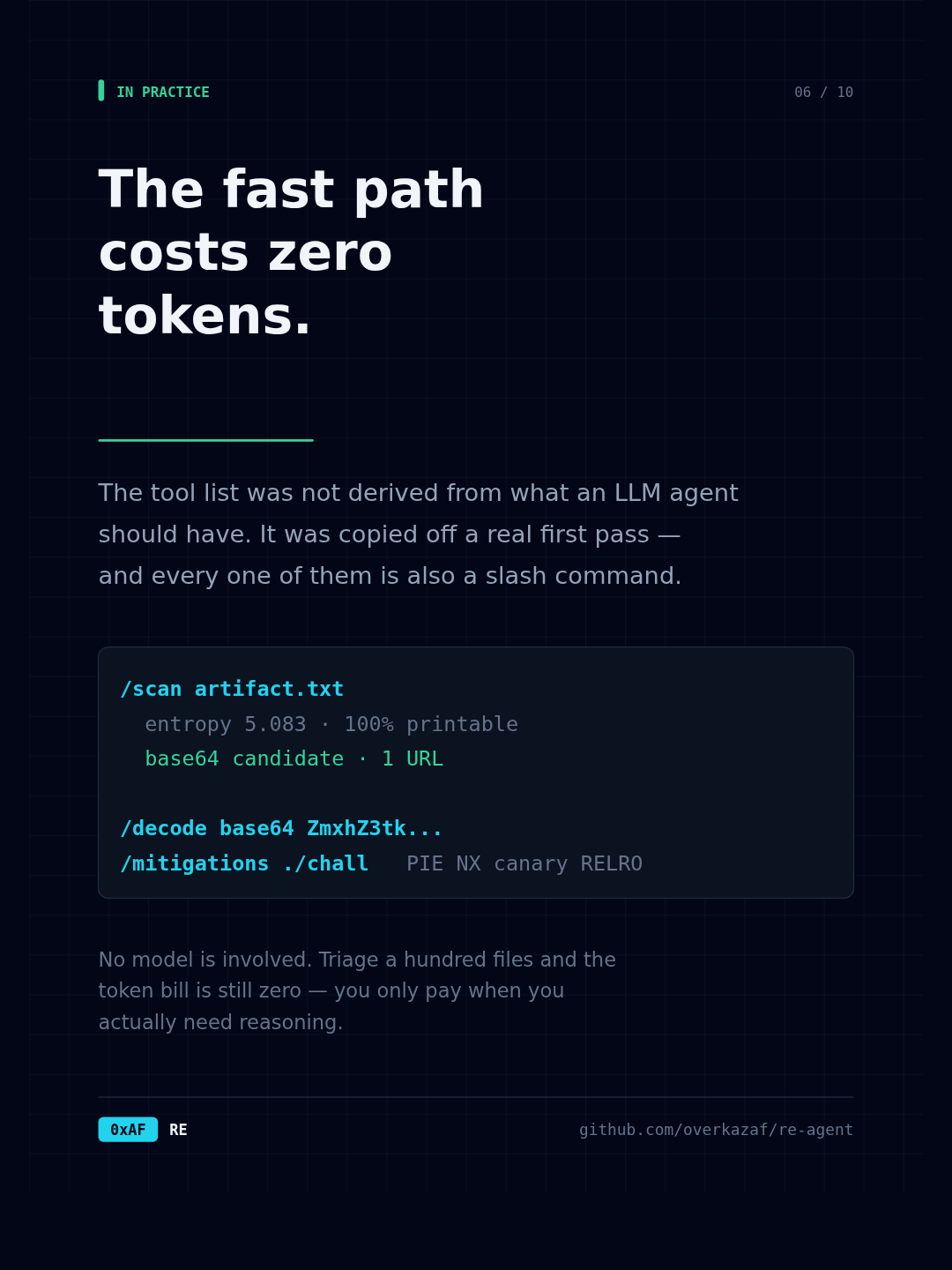
Every analysis tool is also a slash command, so the fast path costs no tokens at all.
This is usually how a session starts.
/scan ./chall                  type, magic, hash, entropy, string signals, next steps
/mitigations ./chall           PIE / NX / canary / RELRO / stripped / dangerous imports
/entropy ./chall               sliding-window entropy — finds packed or encrypted regions
/carve ./blob                  embedded ELF/PE/ZIP/DEX/PNG/PDF/SQLite/Mach-O
/findbytes ./chall flag{       offsets with hex+ascii context; hex needles too
/decode base64 ZmxhZ3s...      base64/hex/url/rot13/xor, or auto to try them all
/apk ./app.apk                 dex, native libs, packer and framework fingerprints
/retool inventory              check radare2, JADX, Ghidra, Burp, mitmproxy, angr and friends
/retool angr template ./chall  emit a symbolic execution harness
/retool radare2 info ./chall   fixed-action wrapper around deeper local RE tools
/retool mitmproxy template api.example.test emit a scoped capture addon
/hook java com.a.Crypto sign   a Frida hook scaffold for the method you name
auto/auto ❯ /scan artifact.txt
Oversized output never lands in context whole: anything past
--max-output keeps head and tail, and the full text is
written to an artifact file the model can read deliberately.
Borrowed tools
Any stdio MCP server's tools join the same registry, with the same approval gate and the
same output budget. For reverse engineering the obvious one is
ida-pro-mcp, which puts
decompilation, xrefs and renaming in reach of the agent.
They appear as mcp__ida__<tool>. A server that fails to
start is reported at boot and skipped, never fatal. /mcp shows
the state of each one.
safety
Tier × mode, and patterns that outrank both.
Two inputs decide whether a call runs: the tool's tier and the session's mode. On top of
that, a command tripping a safety pattern always asks — that is the one case an
"always allow" does not silence, because allowing
run_command is not the same as allowing
rm -rf /.
mode
auto-approves
asks
yolo
everything
nothing
safedefault
every tier
commands tripping a safety pattern
write
read, write
exec tools, and safety patterns
always-ask
read
everything else
safe mode, meeting a network command
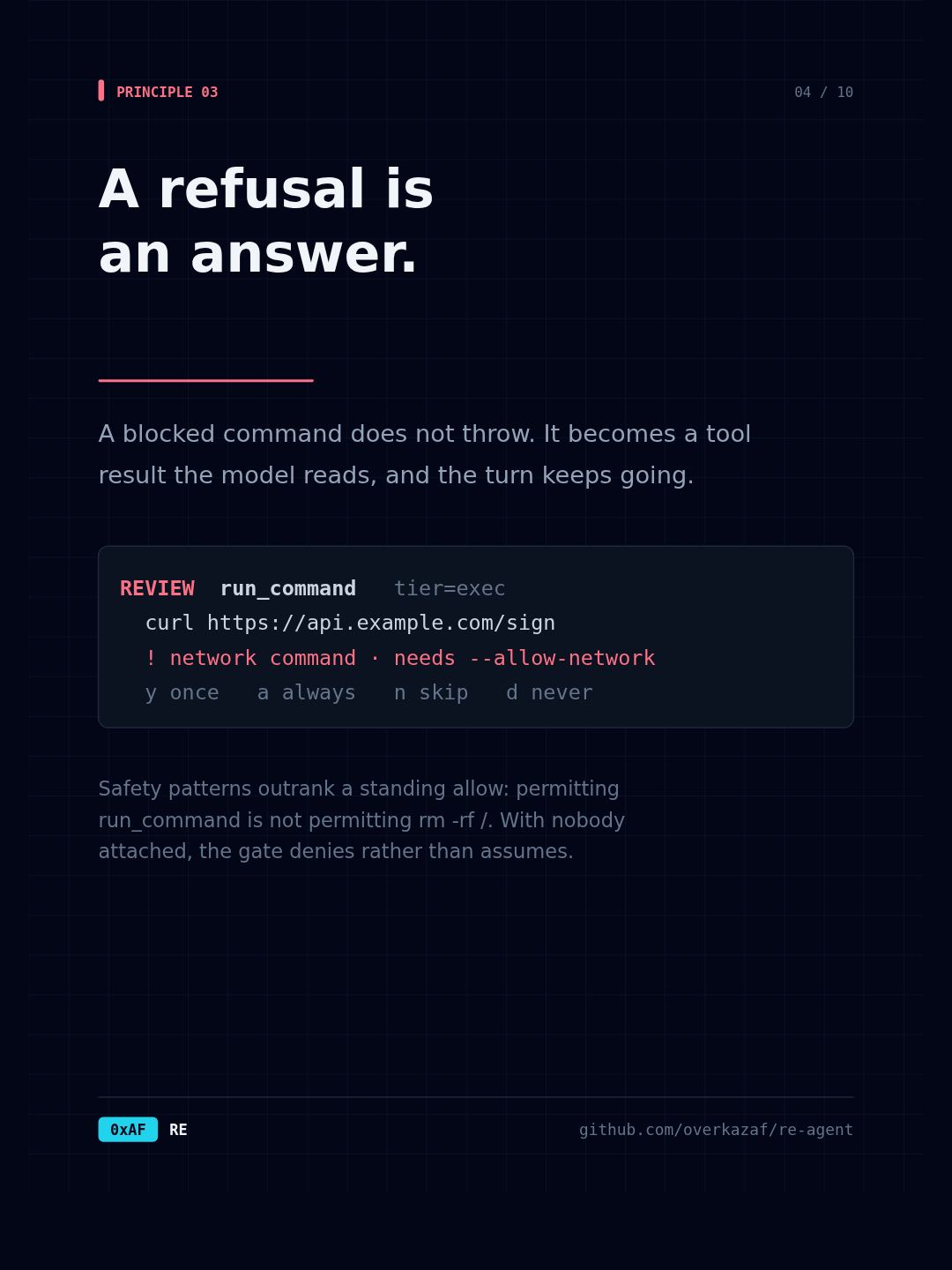
A denial is a normal outcome, not a crash: it becomes a tool result the model reads, and
the turn continues. With nobody to ask — --print, a pipe,
CI — the prompt becomes a refusal that states the reason.
context, sessions, interrupts
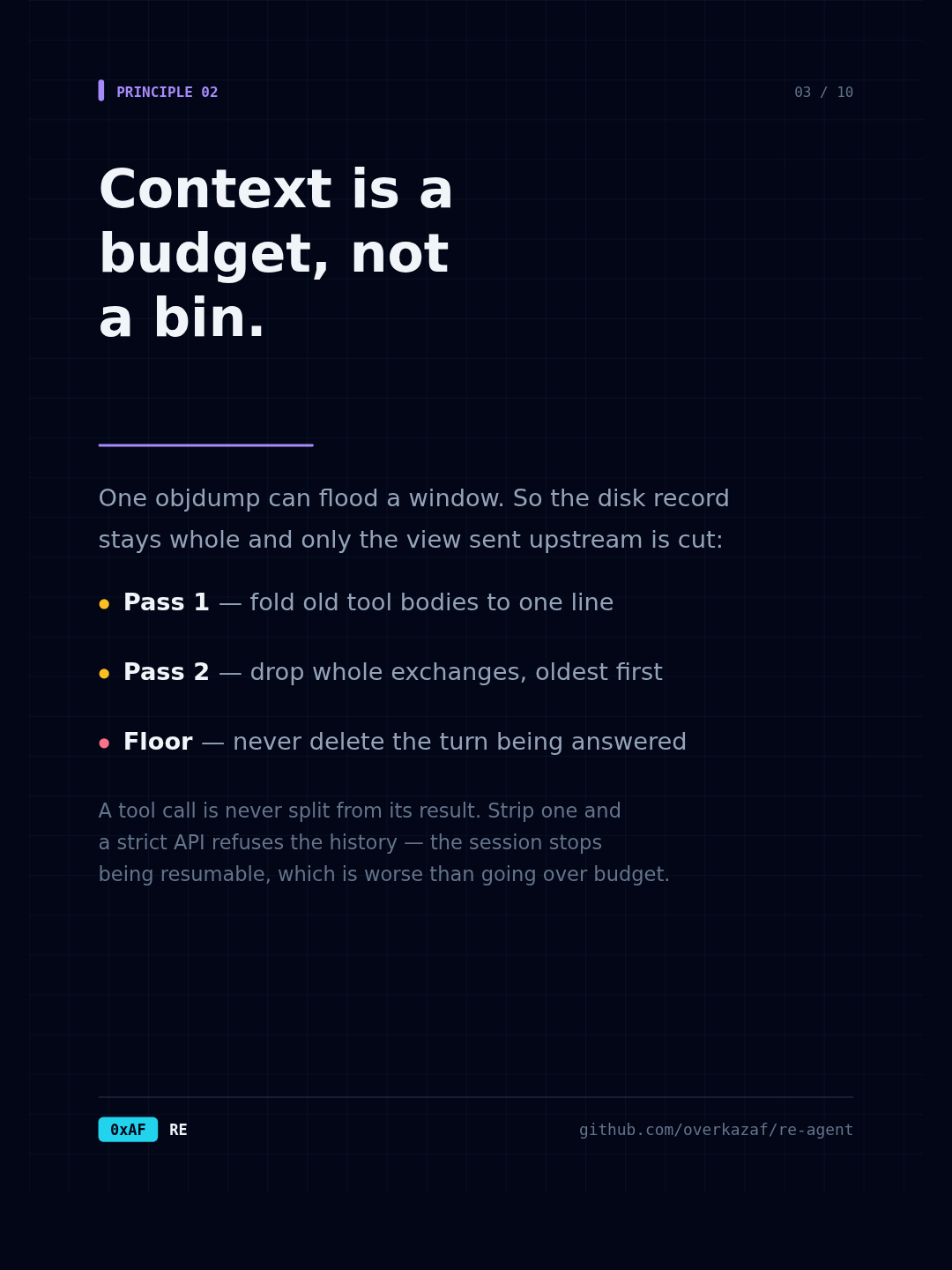
The transcript on disk is complete. What gets sent is not.
Sending everything is how an RE session dies: one objdump -d
can outweigh the rest of the conversation. What goes upstream is trimmed to the provider's
budget in two mechanical passes — old tool-result bodies are elided first, their first
line surviving as a pointer, then whole oldest exchanges are dropped behind a
[context compacted] marker.
A tool call is never separated from its results, because strict chat APIs reject that
shape. The same invariant is why an interrupted turn still records a result for every call
it issued: the transcript has to stay resumable.
/context   ≈12400 tokens of 48000 budget (25%) · 42 messages
/compact   ask the model for a briefing and restart the working history from it

0xaf --sessions          list recent sessions
0xaf --continue          resume the most recent
0xaf --resume 2026-07-28 an id, an id prefix, or a path
Sessions are append-only JSONL. A truncated final line — killed mid-write — and tool calls
whose results never landed are both repaired on load.
skills & knowledge
Your workflows and your notes, in reach.
Project-local workflows live in skills/<name>/SKILL.md.
They are loaded at startup, summarized into the system prompt, exposed as tools, and can
be forced for a single turn. The checkout now ships a broader RE set: CTF first pass,
APK/Frida, native pwn/RE, web/WASM crypto, radare2, Ghidra, JADX, Burp/mitmproxy, angr, Unicorn, unidbg,
and imported local playbooks.
/skills
/skill android-apk-frida inspect this APK and propose hooks
/skill proxy-capture capture api.example.test traffic
A local markdown corpus can be indexed and queried without leaving the REPL. Answers come
only from the retrieved entries, cite the entry ids they used, and if the model cites an
id that does not exist the page says so instead of quietly dropping it — a knowledge tool
that invents sources is worse than one that cites none.
go run ./cmd/import-knowledge ~/notes/re

/know frida ssl pinning   answer from local knowledge, with sources
/know raw frida ssl       raw index hits, no model call
/know read <entry-id>     read one entry in full
install & quickstart
Four commands to a working deck.
# 1 — install
go install github.com/overkazaf/re-agent/cmd/0xaf@v0.1.5
# or: git clone https://github.com/overkazaf/re-agent && cd re-agent && make build# 2 — check the wiring, offline: no key, no network, no CLI login
0xaf --smoke
# 3 — check what it can actually authenticate as
0xaf auth status
# 4 — open a workspace
0xaf --workspace ./ctf
The default route uses your local codex and
claude logins through tmux. Prefer a direct API? Export a key
and name the provider:
export DEEPSEEK_API_KEY=...
0xaf --planner deepseek --executor deepseek --workspace ./ctf

# or store one locally, in ~/.0xaf-re-agent/secrets.json
0xaf auth login claude-api
A shell escape, when it is faster to just look
A REPL line starting with ! runs in the workspace under the
same policy. Output streams live and lands in the transcript, so the next prompt can
refer to what you both just saw.
auto/auto ❯ !ls -la · /read nope.txt
Same policy as run_command · ^C kills the child, not the REPL.
auto/auto ❯ /help
TAB completes commands and their arguments; a live palette
appears under the prompt as you type; ↑↓ walks history that
persists across sessions.
verification
Ten test packages, and a startup you can measure.
The tests pin the parts that are easy to break silently: the context-budget invariant, the
plan tracker's no-op suppression, the CLI task-table binding rules, the approval matrix,
and the HUD's width and height contract — a single over-wide line would desynchronise the
in-place redraw for the rest of the session.
go vet · go test · build · startup
Fifty process starts in 0.335 s — about 6.7 ms each, including reading the embedded prompt and skills.